Mr. Winkle at Utah Museum of Contemporary Art
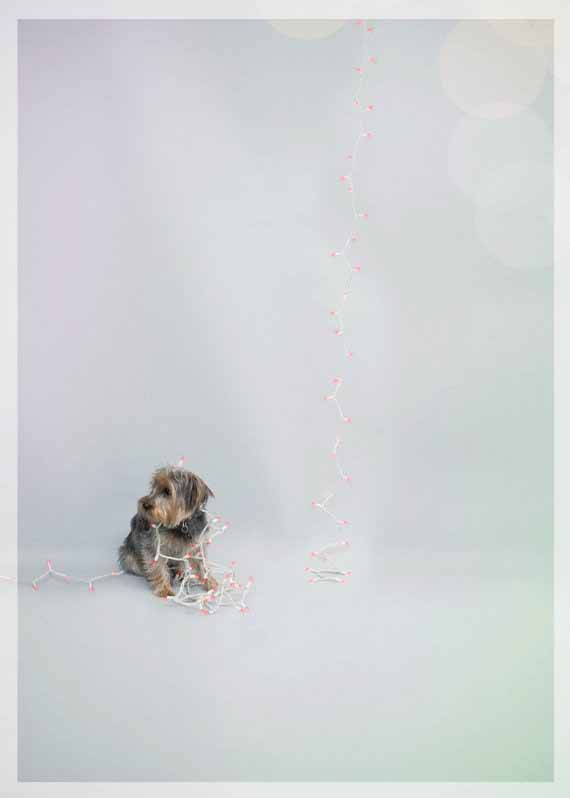
Mr. Winkle: Object of Projection – Photographs by Lara Jo Regan is now on view at Utah Museum of Contemporary Art. The exhibition features over 60 photographs of Regan's legendary dog, Mr. Winkle, who is considered by many to be the first major Internet celebrity. If you don't know Mr. Winkle, you probably weren't on the Web back in 2001 when his fame exploded. By 2002, Mr. Winkle's website had garnered over 40 million hits, and Mr. Winkle was named “Internet Celebrity of the Year” by Time Magazine’s On publication. For the last 10 years, Regan has published a yearly calendar and numerous books starring her adorable, almost unearthly, dog.
What fascinates me is not only the longevity of this early Internet phenomenon (to say nothing of the longevity of Mr. Winkle himself – yes, he is doing well), but also the intersection of kitsch and contemporary art. Readers of Dog Art Today know that "taking dog art seriously" is my mantra here. This blog is devoted to countering what I percieve as a bias against dog art. So I couldn't help being surprised that images of the cutest, kitschiest dog in the world are being explored in terms of the ways "ironic juxtaposition can incite dialogue about empathy, projection, human-animal relationships, and the nature of cuteness itself" at a mainstream contemporary art museum.
I had many questions for Lara Jo Regan. She graciously answered them.
Corner Curve, Los Angeles, California, 2005
Moira McLaughlin: How did the Mr. Winkle: Object of Projection exhibition come about? Did you approach the museum (or many museums) or did the Utah Museum of Contemporary Art come to you with the concept?
Lara Jo Regan: One thing I have learned about the art world is that it is extremely difficult to approach museums and galleries out of the blue with an idea. Unlike the magazine world, which is equally competitive but much more open, gallerists and curators are generally more responsive to things they have discovered or thought of themselves.
Micol Hebron, the curator of Mr. Winkle's show at UMOCA (and proud dog owner), had a longstanding interest in the concept of cute and why it's often not taken seriously in art. She was fascinated by its seductive powers, its universality, and its anthropological and biological origins. Also, she had been a longtime Mr. Winkle fan going back to the time she taught junior high and used Mr. Winkle images to alter the mood of misbehaving students. It was entirely her idea to do a show exploring the concept of cute through a survey of Mr. Winkle photographs. She felt the photographs were culturally significant since Mr. Winkle was the first Internet superstar, and because the images epitomized many issues she wanted to explore. She was also interested in an artist’s obsessive relationship with a non-human, untraditional muse. At first I surprised, but then it occurred to me that there is nothing out there like the Mr. Winkle collection.
A Suspect?, 2002
MM: Before you met Mr. Winkle you were an award-winning documentary photographer. When you began photographing your dog and then promoting his calendars and books, were you concerned that the "cute factor" would diminish your reputation?
LJR: At first it was a big concern. Mr. Winkle burst onto the scene about the same time I won World Press Photo of the Year for The Sanchez Family, a photograph that was part of a series I did on poverty and disenfranchisement for Life Magazine. It was the last big commission they granted before ceasing their iconic monthly publication.
The Sanchez Family by Lara Jo Regan
Also, I had been getting prime assignments from the world’s biggest magazines; all my dreams had already come true with interest. So it did cross my mind that Winklemania would shatter that identity, render me “not serious after all,” or a sell-out in the eyes of my colleagues.
But as the fan mail poured in to mrwinkle.com, I realized that Mr. Winkle’s impact on people was far deeper than I imagined. Thousands of people with trauma and life-threatening illnesses attested to his seemingly miraculous power to heal, soothe, and comfort. Also, he quickly became a poster child for the beauty and potential of adopted strays. I can’t tell you how many people came up to me on the street claiming they decided to adopt an animal in need because of Mr. Winkle.
During this time, I had the opportunity to donate funds to numerous animal causes as charities sought us out. And, I was able to to incorporate highly educational and inspirational content into a series of Winkle books I created with Random House. I made a very conscious decision to use Mr. Winkle’s fame in the most positive way possible: to raise awareness about the things that need more attention in our culture, exactly like I was doing with my documentary work. I was just doing it on a different wavelength, a different stage, but my inner impulse was the same. Although, I’m sure there are those in the documentary world who still look down on it all.
The Relax Inn, Needles, California, 2004
MM: Has the Mr. Winkle phenomenon impacted your career as an artist and journalist positively or negatively?
LJR: It has impacted my career as a journalist negatively, because I simply did not have time to do the very demanding editorial assignments after Winklemania hit. That was extremely painful. But I had too much content to produce to fulfill contracts with those who licensed Mr. Winkle images. More importantly, I felt like I had been blessed with a dream muse in Mr. Winkle, whose limited time on earth required my full attention as an artist. That line of thinking ultimately paid off, resulting in Mr. Winkle: Object of Projection, my first solo museum show. So the impact on my art career was undeniably positive.
Adrift, Flagstaff, Arizona, 2004
MM: Do you remember the moment when you realized you had created an Internet sensation with your dog?
LJR: I remember the moment exactly. Being that I had a tiny budget to start mrwinkle.com, I had hired these two adorable geeky computer science students at USC to run some of the technical stuff from their dorm room. The website had been created and had gone live, but a couple weeks had gone by with no action – something the naysayers had warned me would be the more likely outcome of my crazy scheme. After a painful dentist appointment, I stopped by their dorm room for a meeting and knocked on the door. A seemingly rattled voice behind the door said, “Come in.” Entering their cave-like room, both guys were sitting transfixed on their computer screens. “Is something wrong?” I asked nervously. Without getting up, one of them turned his head and looked at me with wide-eyed-deer-in-the-headlights amazement and proclaimed, “Its gone viral.” It was like a funny scene out of John Hughes movie.
A Cauliflower?, 2005
MM: I was delighted to find that the Mr. Winkle website is exactly how I remember it from 2001. Visiting it was a total flashback one rarely experiences on the Web. How did you resist the temptation to update mrwinkle.com? And why?
LJR: I resisted the temptation for the same reasons preservationists work to preserve the architecture of historical buildings that are iconic of an era. Once the site became popular and Internet technology began to rapidly advance, there were many professional solicitors urging me to make it “slicker” and more “state of the art." But my mind kept harking back to a piece of fan mail from a man who said he was utterly taken with the weird and endearing “love-craftian” vibe of the site. That handmade sincerity was not only one of the elements that made it popular and unique, but it represented a certain era in early Internet history that I wanted to freeze in time. So often when something becomes popular the very soul of the thing gets obliterated by outside interests who seek to alter or exploit it. I was determined to avoid that.
A Kitsch Object?, 2007
MM: One of the reasons I started Dog Art Today is to show that dog art is not all kitsch. I have argued that dog art can be fine art. But recently I noticed kitsch is now being celebrated as fine art and I wrote about reconsidering my anti-kitsch crusade. Do you regard your Mr. Winkle oeuvre as kitsch? Do you think kitschy work can be fine art?
LJR: I think just about anything can be art, depending on the breadth and depth of how it is explored, and how it relates to the culture at large. For instance, a ceramic kitsch knickknack of a puppy mass produced in China to sell at Rite Aid is not art. But if a serious artist collects these objects and uses them in her art in a way that transforms not only the objects but the meaning of them themsleves, then it is possibly art – depending on a host of other things like the originality of the artist’s concept, the skill of her execution, etc. The transformational quality is key. For example, Jeff Koons, one of the most prominent contemporary artists of our time, has been using kitsch objects in his art for most of his career, making gigantic sculptures based on them, like his famous gigantic stainless steel bunny inspired by an inflatable toy. The sheer scale of it transforms the original meaning and incites contemplation about the place such objects occupy in our cultural consciousness.
Mr. Winkle is a living kitsch object. But I chose to re-contextualize and transform him in various bodies of work. The resulting artwork does not fit the standard definition of kitsch: something “poorly done” that appeals to “lowbrow” taste (a definition I find condescending and overly simplistic to begin with). In the Mr. Winkle Nature Nudes series, I placed him in settings we usually associate with human nude studies, against rocks, trees, etc. In the Hotel-Motel series, I captured him posing in the kind of gritty and mundane Americana settings one may associate with documentary artists like Stephen Shore or William Eggleston.
The What is Mr. Winkle? character collection has the largest kitsch quotient, but it is offset by the fact that these seemingly cutsie tableaus often reference history and poke fun at our culture. The whole Mr. Winkle collection, in fact, is an intentional twist on many traditions in art history combined with an artist’s true love of a highly unusual muse. But, even the more “commercial” character series had its limits in the mass market. According to the company who licensed over 70 Mr. Winkle character photos as cards, many of the images were just too “complex and weird” to sell well in a greeting card market whose customers usually prefer the kind of straightforward simplicity that a porcelain puppy knickknack offers.
Sunshine State, Clearwater, Florida, 2004
MM: How has the exhibiton Mr. Winkle: Object of Projection been received by the art establishment? Was this a risk for the Utah Museum of Contemporary Art? Was it a marketing ploy? Both? Any backlash from the museum's patrons?
LJR: It was initially quite controversial, particularly to those who could not get past the cuteness of the subject and see how much is was going on in the images. In some ways I understand; cuteness is extremely powerful, and our knee jerk reaction is to associate it with mawkish or manipulative marketing ploys. But its power and the instant prejudice against it in the art world is why curator Micol Hebron thought it worthy of exploration. For eons, nature has selected for cuteness (neotenic features like large eyes, small limbs, etc.) in babies to impel parents to want to take care of their offspring and ensure the survival of the species. It is a universal, profound, and timeless intinct, as is love, beauty and sex, topics that are readily accepted as appropriate subjects of art. In my opinion, if someone dismisses otherwise serious art just because it is cute, that is simply prejudice at work like any other prejudice. Overall, the show has been extremely well received, even among the serious patrons. One man who attended the opening who owns a gallery in town summed it up beautifully. He said, “At first glance these images seemed like kitsch, but when I spent more time with them I realized there was a lot more to them – they crept up on me, in a good way.”
MM: Do you think Mr. Winkle knows he's a celebrity and do you think he has enjoyed his fame?
LJR: Most dogs love to have jobs, be it fetching, herding, or protecting. They are natural pleasers. Mr. Winkle does not please via the more traditional doggie duties, but he could not wait to pose for pictures. He understood that this was his job. He loved the attention bestowed upon him, not to mention the fresh chicken strips he was rewarded with during the photo shoots (his scale pay). At book signings, he never tired of posing for pictures and soaking up the adoration, even after hundreds of “pawtagraphs.” The little stud knew exactly what was going on and he reveled in it. I would never put animal through anything he did not enjoy.
MM: Many artists who view their dogs as their muses struggle with creating enough images (photographs, paintings, sculptures, etc.) of their pets because there are never enough. And, as one's dog ages, a panic to "capture" the dog may take hold (I know it did for me as my dog aged). Have you experienced this? If so, how do you handle the mortality of your muse?
LJR: I handle the mortality of my beloved muse by capturing him every which way, so he will live on forever through art. I even made a live action film to immortalize him in motion, which is also screening at the museum as part of the show. My natural impulses as a documentary photographer, the need to capture something amazing – and the glorious way it makes me feel – apply to my work with Mr. Winkle.
Though I stopped photographing Mr. Winkle several years ago, it was due more to wanting him to relax in his golden years than his aging looks. The Madison Avenue mentality that photography subjects must be young and perfect should be avoided in art, because one of the important roles art serves is to counter the seductive illusions of entertainment and advertising that permeate our culture. Telling the absolute truth, whether it be an inner or outer truth, expands hearts and minds. Aging dogs have a special vulnerability and dignity, a different kind of beauty that should be celebrated. It's a beauty that should be celebrated in all of us, in art and in life.
Silver Fox Hole, Los Angeles, California, 2005
Mr. Winkle: Object of Projection – Photographs by Lara Jo Regan is on view at Utah Museum of Contemporary Art in Salt Lake City until October 20, 2012. More information here.
In honor of the exhibition, Lara Jo Regan has produced a new book, Mr. Winkle: The Complete Character Collection. Order it here.
Mr. Winkle: The Complete Character Collection available
here
Mr. Winkle's 2013 Calendar The Nudes: Volume 3 looks like a classic. Order it here.
Mr. Winkle's 2013 Calendar
The Nudes: Volume 3 available
hereGo to Mr. Winkle's website to see it all and take a trip back in time.
Visit Lara Jo Regan's documentary photography website to see more of her work.
Thank you, Lara Jo. Please give Mr. Winkle a hug from me. I am a big fan.