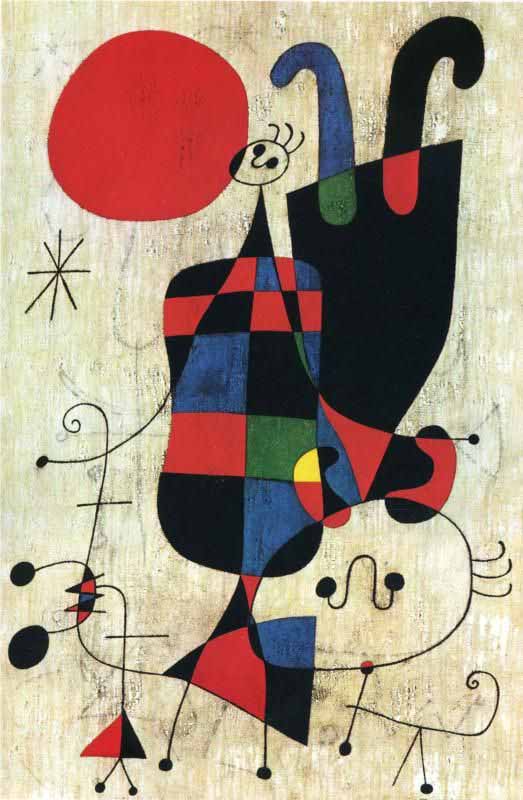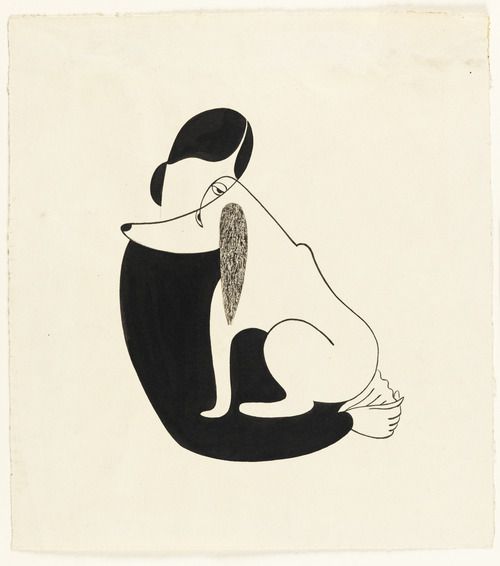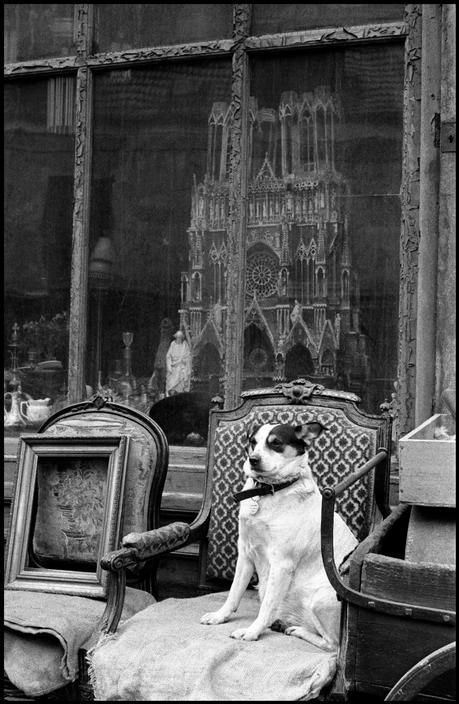
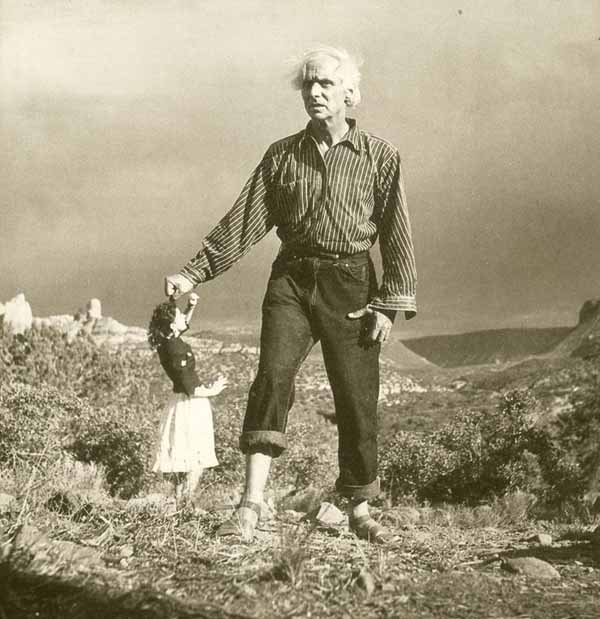
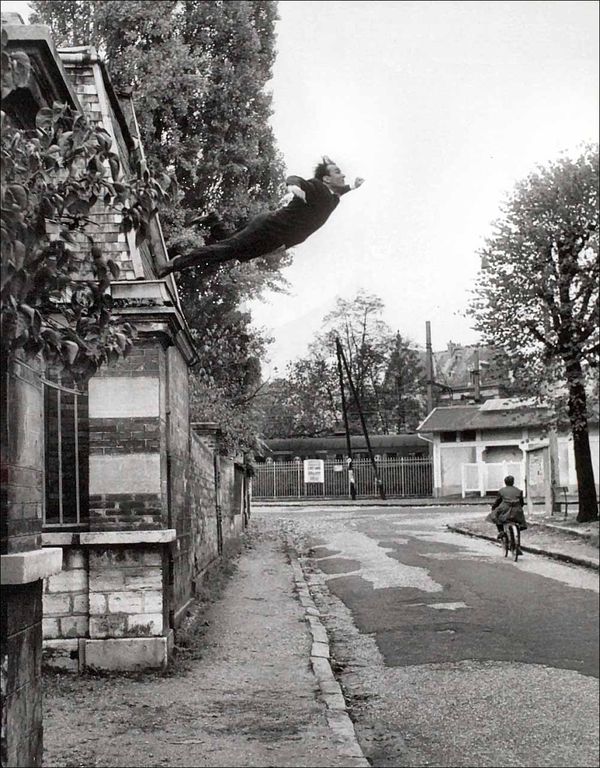
Paris, 1958 by Inge Morath
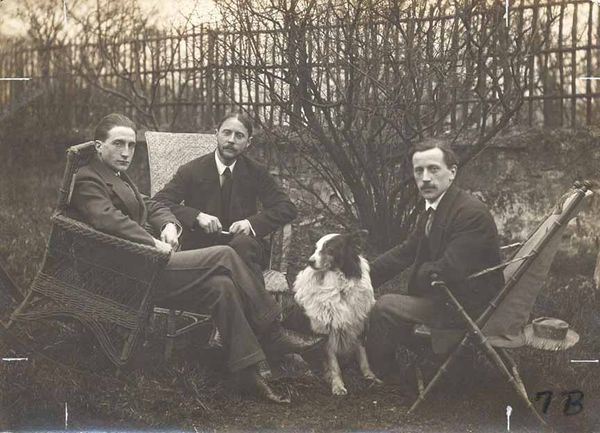
Worship your dog today.
Via Inga Morath
Looking back at our DANK Experiment this summer I had some thoughts on how to start your own artists collective…
1.) Be Organic. Meet weekly for coffee. Share interstes. Do a project together. Let everyone participate, the whole town. See who shows up. Do another project. See who shows up again. Exchange long email threads not on Facebook (this will feel very intimate). Then, after a year or so, form your collective with the people who are still meeting for coffee.
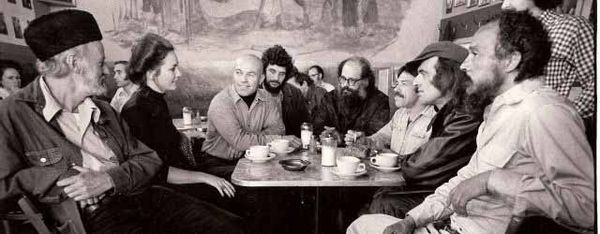
2.) Include both genders. I'm not going to lie, stuff will come up when men and women work together. But, your collective won't defined by gender (women only) or lack of diversity (men only). Also, testosterone is soooo handy…Is that sexist?
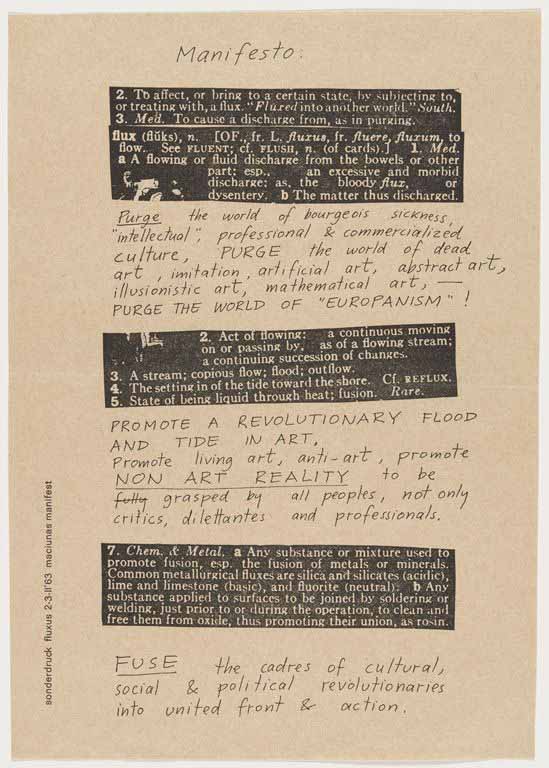
3.) Put it in writing. A group of artists will have lots of ideas, probably too many. Writing a manifesto, a mission statement, and/or a press release, makes you focus your goals, be able to explain them to others, and, most importantly, enables others to write about you. Jack Kerouac may have coined the phrase "Beat Generation" in 1948, but John Clellen Holmes introduced it to the world in this New York Times Magazine article in 1952.
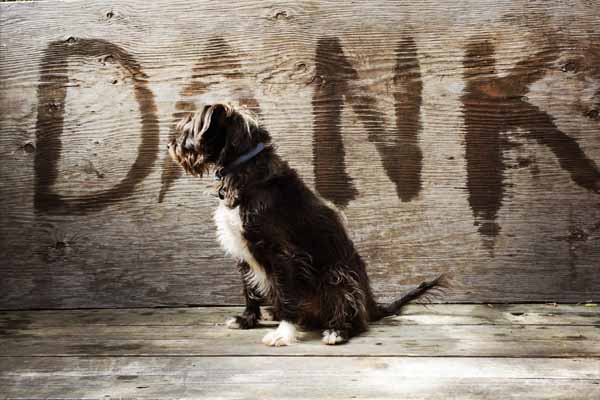
4.) Pick a good name. Avoid the too dry (Critical Art Ensemble), the spelled weird (gelitin), or the impossible to remember (0100101110101101.ORG). We love DANK because it popped out of Joe Meade's mouth as a description of a space in town and we couldn't stop using it as a noun, adjective, pun, and acronym for Do Art Now Kids. It was organic (see #1) And it resonates with Nevada City's cannabis culture. But, having your name mean something else creates issues too. If you Google DANK you'll see more images of DANK weed than DANK art.
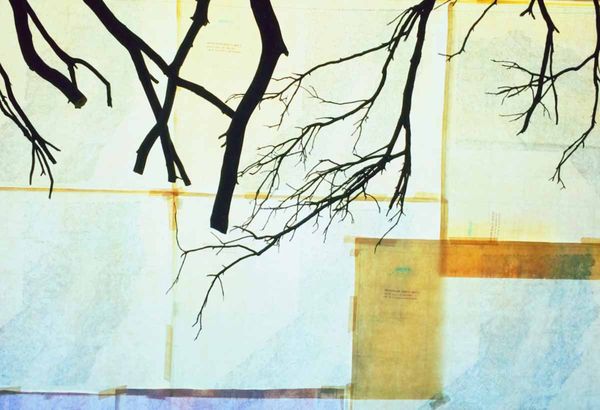
5.) Passion beats consensus. If someone feels super strongly about covering all the windows with maps, and has the maps, and is willing to pull an all-nighter, alone, to do it, he wins. If someone feels super strongly about how gross the bathroom is, and is willing to clean it, make it cool, and open to the public, she wins. Step out of passion's way and allow for individual awesomeness.
6.) Know the difference between "community context" and gossip. "Community context" means sharing information, e.g. what printer, merchant, or artist is a swindler, racist, or maniac: crucial things to know. But avoid conversational gossip, especially about each other. No one wants to feel like s/he is the topic of conversation the minute s/he leaves the room.
7.) Be scared, but do it anyway. Only feasible if you stick to #6.
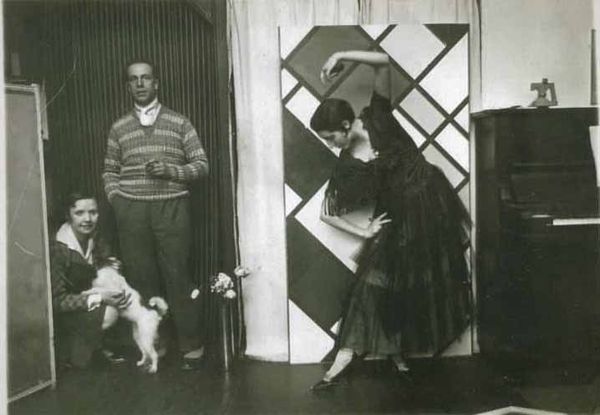
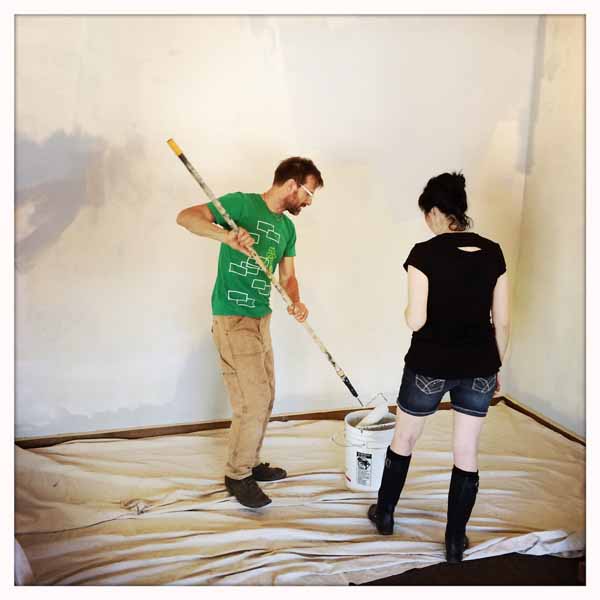
8.) Take lots of photos. Hopefully one of you is a photographer and all of you play around with photo apps, social media, and hashtags. Your photos don't have to be professional, but they should be interesting. You're artists goddammit. Make yourselves look good. Also label your jpegs. For example the photo below is DANK-Joe-Meade-Celine-Adrianna-Negrete-by-Moira-McLaughlin-2014.jpg. Seach engines will love you and your biographers will thank you.
9.) Track your finances, but keep financial pressure out of it. We are fortunate to have a rigorous CFO. Roseanne Burke loves to make spreadsheets and reconcile the books to the penny. You might not be so lucky, but at least talk about money and get a clear understanding of the costs and who's willing to "buy in." Balance between conscientiousness and fluidity. New expenses will arise and you don't want budget meetings to devolve into "who ordered just an appetizer and who only drank water." Also, avoid overhead or you can easily find yourself raising rent money and not making art.

10.) Ten is an excellent number of members. It's so easy to divide by.

DANK is an artists collective in Nevada City, California. It was founded in 2013 by ten artists interested in post-Great Recession social issues, and a rural aesthetic grounded in the legacy of the California Gold Rush.
The name DANK comes from the wet wood smell that permeates Nevada City, a town situated on the banks of Deer Creek. It’s also a nod to one of the area’s premier exports, cannabis. And it’s an acronym; Do Art Now Kids.
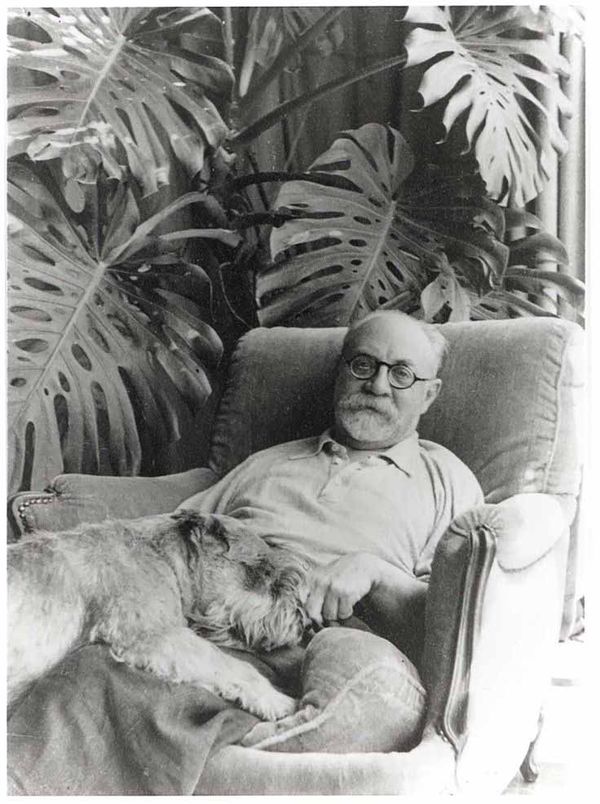
Holland Cotter of The New York Times gives "Henri Matisse: The Cut-Outs," now on view at MoMA, a glowing review that, as a collage artist who spends a lot of time in bed, I found very inspiring.
Above photograph is courtesy of Tate via Miss Moss who has a beautiful collection of photographs of Matisse with dogs other animals here.

Happy Birthday, Frida Kahlo and my mom, Kit McLaughlin.
Via Mediastore.
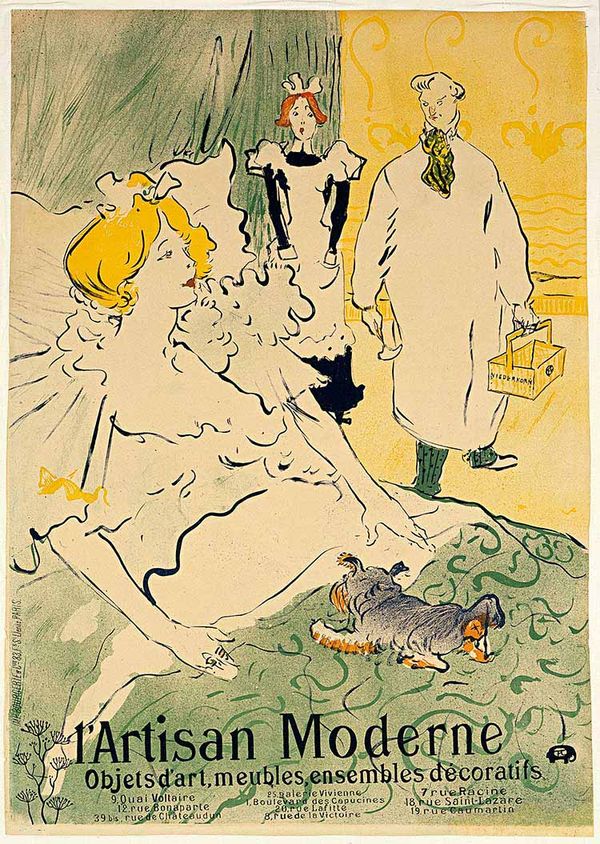
Now on view at the Blanton Museum of Art at The University of Texas at Austin, In the Company of Dogs and Cats, featuring over 150 works by masters such as Albrecht Dürer, Jean-Honoré Fragonard, William Blake, Francisco Goya, Paul Gauguin, Takahashi Hiroaki (Shotei), Pablo Picasso, Henri Cartier-Bresson, Edward Hopper, Louise Bourgeois, and others.
The museum is keeping most of the included works out of the press, but shared L'Artisan Moderne Poster by Henri Toulouse-Lautrec. I've never seen it before. Wonder what other dog-art treasures they have? If you go, let me know.
Exhibition runs until September 21, 2014.
Visit Blanton Museum of Art for more information.
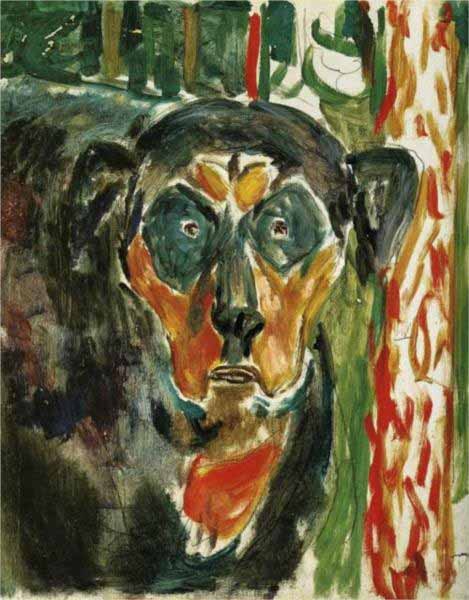
Who knew Edvard Munch was a dog artist? Thirty-seven years after The Scream.
Via Wikiart.

For the last year, my friend Nevada City artist Roseanne Burke, has been working on a series of 20 encaustic portraits of women artists. As she shared her subjects with me, I began to see a trend; these women loved dogs. Many, like Frida Kahlo, Georgia O’Keeffe, Virginia Woolf, and Marilyn Monroe, I had already featured here on Dog Art Today. A few, such as Mary Cassatt, Josephine Baker, Beatrice Wood and Ruth Asawa, required some research that turned up wonderful photographs and paintings of the artists with their canine companions.
In the end, it turned out 90% of the women had dogs. And Roseanne has two pups. So, although her exhibition, The Cool Girls: Encaustic Portraits of Remarkable Women, which opens this weekend, doesn’t include a single dog, I see it as much as a celebration of dogs as muses as women as artists.
I asked Roseanne if I could interview her about this dog/artist connection and she graciously agreed.
Moira McLaughlin: What was the initial spark of inspiration for this series?
Roseanne Burke: I had always been intrigued by encaustics, a process of painting with hot wax. And in 2013, I took workshop on it with local artist, Deborah Bridges. Although I had not done much portraiture, as I experimented with the medium, I immediately saw possibilities that I wanted to explore.
That same year, I watched the PBS documentary Makers: Women Who Make America about the struggle for women’s equality in the United States during the last half of the 20th century. Narrated by Meryl Streep, it featured interviews and archival footage of women from all social strata, from politicians and television stars to flight attendants, coal miners and phone company workers. As a woman who came of age in the 1970’s, I was struck by how hard so many women had fought for the rights we now enjoy and how much we stand to lose if we don’t stand up to the current political backlash against us. The Cool Girls is the intersection of these two events.


MM: How did you define “remarkable” and make your selections?
RB: I chose women whose work inspired me personally, who were internationally recognized for their art, and who did other remarkable things with their lives. My research on one woman would lead me to others. And, as I learned how multifaceted each one was, I discovered these women had accomplished so much more than I had been aware of, especially socially and politically. That brought the project full circle for me, since the recent attempts to limit women’s rights was one of the inspirations of the series.


MM: Do you see a correlation between dogs and art and how would you describe it?
RB: Dogs are love wrapped in fur. No matter how you are feeling about yourself on any given day, your dog loves you and thinks you are the best. I think artists often go through periods of frustration, self-doubt, artist’s block, and have pretty negative feelings about their work and perhaps their own value. Having a dog, an animal who absolutely loves you unconditionally, just makes you feel valued and sets you back on the right mental path. Maybe that's why so many of these artists had dogs.


MM: Did you discover other similarities between the women?
RB: The biggest similarity was their need to create their art. Many of them faced huge economic, social and political obstacles, but the forged ahead and made their art regardless.
MM: What surprised you the most in your research?
RB: I was really surprised by how many connections there were between the women. Some were subtle, for example the subject of Toni Morrison’s master’s thesis was suicide in the writings of Virginia Woolf. Some were direct; Josephine Baker and Frida Kahlo were lovers.
I was also reminded of the power of “sisterhood” as I discovered how these women helped and supported each other. For example, when Yayoi Kusama was having financial problems, Georgia O’Keeffe helped her to find a gallery and patrons and even offered her a place to live. And when Beatrice Wood was in her eighties and wrote her autobiography, Anaïs Nin convinced her own agent to represent her. These generous acts lead me to reflect with gratitude on the fellow artists (men and women) in my life who share information and experiences and help me make sense of the whole process.


MM: You began this series with one dog, Harry, your sweet, mellow 11-year-old Australian Shepherd mix, and then adopted Lyra, a rambunctious 12-week-old Terrier mix. I know you to be a meticulous planner. Do you think you were channeling the fearless spontaneity of one (or more) of these women when you got a puppy in the middle of preparing for this ambitious solo show? If so, who?
RB: My partner Jim and I had been planning to get another dog for the past two years. I had been looking on Petfinder.com and had applied for a few puppies, but they didn’t work out. When we saw Lyra, we arranged to meet her a few days later and decided that she was the one.
Once we made the decision, I knew it would all work out. I am a meticulous planner, but sometimes you just have to make a bold move. Everything of value in your life requires some effort or sacrifice. I could definitely use more sleep since we got Lyra, but she is so joyous, spunky, curious, and spontaneous and adds so much to our lives. I don’t really see myself as channeling the spontaneity of any particular woman, but dogs just make your life better – and most of the women seemed to have thought so too.


MM: How have Harry and then Lyra informed your work?
RB: Dogs just make you happy. And I do better work when I’m happy. They help me to stay in the moment and stay focused on the now. Even though Lyra demands a lot of time, strangely that has helped me stick to a very organized and regimented schedule. I’ve actually made more art since I got her.
MM: You are an avid reader of Dog Art Today and my best tipster, so I know you know your dog art. What are your three favorite pieces of dog art?
RB: Birmingham 63 by Jack Levine, 1963, Noel and Bob by Joan Brown, 1964, and Puppy by Jeff Koons, 1992.


MM: I consider you a dog artist because you are a painter with dogs. And, I love the one painting I know of yours that features a dog, Ike’s Quarter Cafe. Do you have plans to paint your own dogs in upcoming works?
RB: I had always planned to commission a painting of Harry from one of many wonderful “dog artists.” Since we got Lyra, I’ve been taking lots of photos of the two of them together, and have been encouraged to do a painting, so we’ll see. Right now, I’m pretty focused on the women.


Thank you, Roseanne. I'm so inpired by these women and your "remarkable" work.
Visit Roseanne Burke's website to see to see all 20 women.
If you’re near Nevada County, please come to the opening reception for The Cool Girls: Encaustic Portraits of Remarkable Women this Saturday, April 26 from 4 – 7 pm.
Szabo Vineyards Tasting Room
316 Broad Street
Nevada City, California 95959
Exhibition runs until May 30, 2014.
Well-behaved dogs are welcome.*
*Tyler Foote was asked to leave after barking at a sassy Dachshund.
Did you hear this crazy true-crime story about the Italian auto worker/art lover who paid 45,000 Lire (approximately $100 adjusted for today) for two paintings at the Italian Railways lost and found auction in 1975?
The paintings turned out to be Fruits on a Table with Small Dog by Paul Gauguin, and Woman with Two Arm Chairs by Pierre Bonnard.
They were stolen from a London art collector in 1970 by two men posing as burglar alarm technicians.
Authorities think the thieves abandoned the paintings on the train due to fear of customs.
The paintings hung on the auto worker's kitchen wall for close to 40 years. Their identity was only discovered when the man died and his son decided to sell them. Upon researching the paintings, he realized that the dog look very similar another Paul Gauguin dog painting.
Now, it's been discovered that the original owner died and left no heirs.
The paintings are worth between $14 million and $40 millions.
Who should get to keep them?
P.S. In other art heist news, I just watched four seasons of "White Collar" on Netflix. It's corny, con man, forgery, buddy-genre fun. I really enjoyed it.
P.P.S. I wish there was an undiscovered Bonnard Dachshund too.